

The Swedish Government has announced that it will support FINGER model implementation in Sweden with 51 million SEK (around 4.8 million euros). The main part of the amount will be granted to healthcare regions for implementation projects in collaboration with municipalities. 1 million SEK will go directly to FBHI to support the implementation and use of the FINGER model in Sweden.
In addition, a total of 7.1 million SEK is granted to the Swedish Dementia Center and two quality registers for development projects in the field.
The funding is an important step in the execution of the updated national dementia strategy that was launched by the government in 2025. The strategy emphasizes the importance of preventive measures and enhanced capacities for early diagnoses and individualized healthcare. It also underlines the relevance of knowledge transfer and evidence-based approaches.
Funding to healthcare regions
To strengthen the preventive work, the government has tasked the National Board of Health and Welfare (Socialstyrelsen) with allocating funds to healthcare regions in support of projects aimed at initiating and developing activities based on the FINGER model. The funds shall be allocated during 2026 following an application process, and projects must be collaborative efforts between regions and municipalities. The Board has 50 million SEK at its disposal for this specific FINGER implementation initiative, of which at least 48.5 million SEK shall be distributed to regions.
In addition, the government grants FBHI 1 million SEK to support the use of the FINGER model in regions and municipalities.
– It is very positive that the government are now supporting preventive measures and that those are grounded in the latest research on the impact of lifestyle on brain health, says Miia Kivipelto, who leads the FINGER research. She is the founder of FINGERS Brain Health Institute, professor of geriatrics at Karolinska Institutet, och and director for research and development at the Aging unit, Karolinska University Hospital.
– My team and I interact with many municipalities and regions, and we know that there is strong engagement in this field. There is much to gain from preventive measures, both for individuals and for society as a whole. It is therefore highly welcome that the government is providing support for such initiatives and strengthening the ability of regions and municipalities to work in line with the dementia strategy.
In addition to the funds that are directly related to FINGER implementation, the government are funding the Swedish Dementia Center (Svenskt Demenscentrum) with over 1 million SEK for strengthened support to young relatives and for the development of training materials related to the Cognitive Stimulation Therapy method, CST. Furthermore, 3 million SEK are provided respectively to the national dementa quality registers SveDem and the BPSD register, for further development of their services. Hence, in all, a total of 58 million SEK will be invested in preventive measures, improved dementia care, and enhanced knowledge about cognitive diseases.
Lifestyle factors are important
The FINGER research has shown the importance of lifestyle and environmental factors in reducing the risk of cognitive decline. The FINGER study, published in 2015, was the first major clinical trial to demonstrate this correlation. Since then, FINGER research has continued in many countries and the model has been tested and adapted in different populations and settings. The results are consistent with those of the original study and provide new insights that help us develop the model further and improve our understanding of various risk factors.
The latest research shows that at least 45 percent of all cases of dementia are associated with modifiable lifestyle and health factors. This is shown in the Lancet Commission report published in 2024, which summarizes the results of a large number of studies from around the world.
– At FBHI, we have a close dialogue with the National Board of Health and Welfare to understand how the funding may be used and how we can best contribute to the initiative, says Miia Kivipelto. We already collaborate with municipalities and regions that plan to implement the FINGER model. With the governmental funding we will have improved possibilities to develop methods and tools to support the implementation in an effective way.
The dementia strategy is titled “Every day counts”, reflecting the aim for everyone to life a full life, their entire life. It is also true in prevention. It is never too early and never too late. There is always something you can do, throughout life, to reduce the risk, delay the disease progression, or make life easier for those affected.
Press release from the Swedish Government: Dementia care must improve (12 Feb. 2026) – in Swedish
“Every day counts” – National dementia strategy 2025–2028 (Swedish Government) – in Swedish
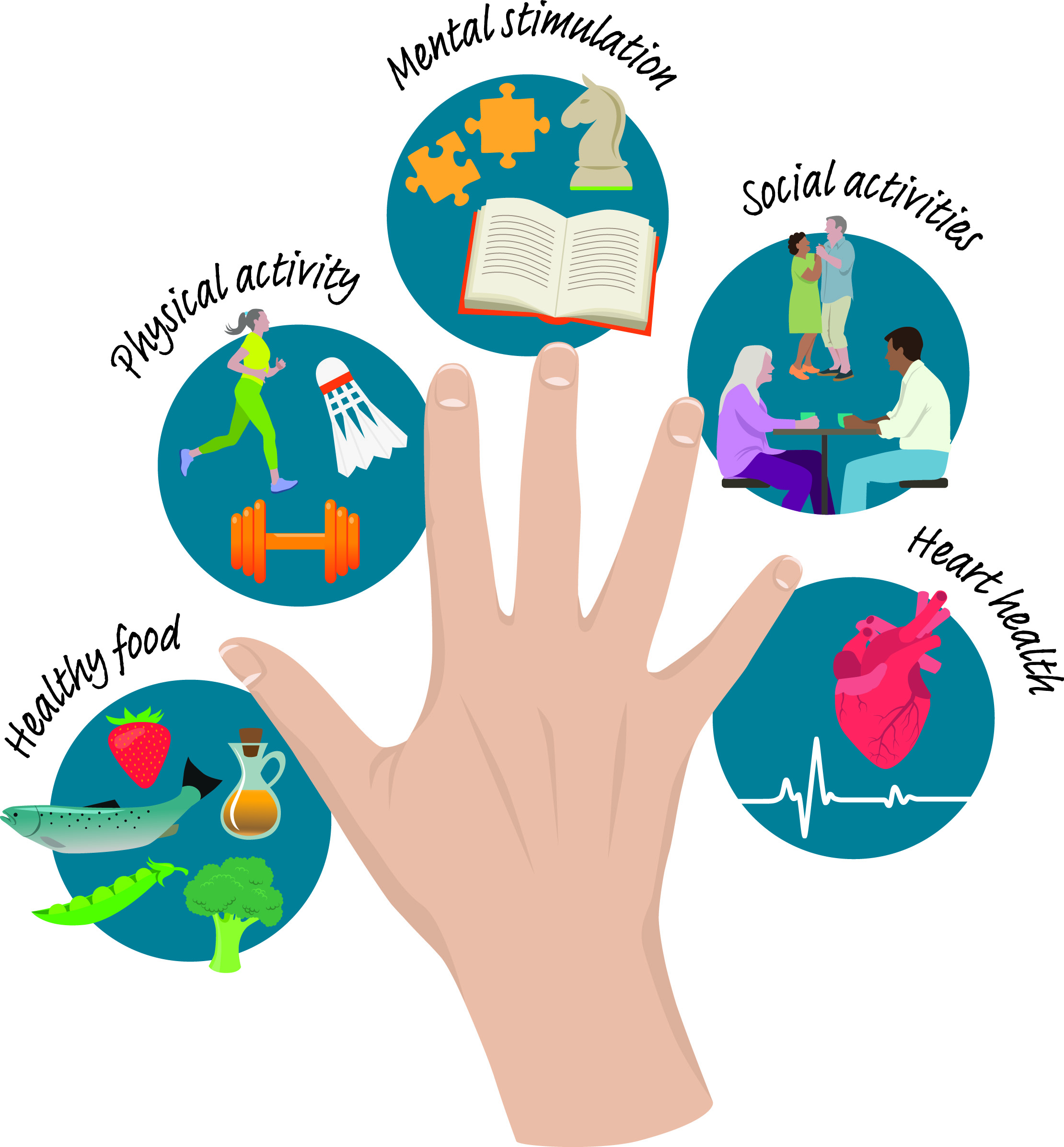
The FINGER model
The FINGER research shows that implementing or maintaining healthy lifestyle habits in five key domains can reduce the risk of cognitive decline.
- healthy diet
- physical activity
- cognitive training
- social activities
- monitoring of cardiovascular health
.
With continued research, more factors have been added:
- hearing and vision
- oral health
- stress
- sleep
.
The model can also reduce the risk of other chronic diseases and frailty and improve health-related quality of life.
 Dementia in Sweden
Declining brain health is a rapidly growing challenge that affects individuals, their families, healthcare systems, and society as a whole, including societal health economies.
- 160 000 persons live with dementia in Sweden and the number is estimated to double by 2050.
- Every year, 25 000 new persons are diagnosed with dementia.
- International studies indicate that 15% of the population over 60 years of age have mild cognitive impairment, and about half of these cases are caused by Alzheimer’s disease. This corresponds to around 200,000 persons in Sweden.